
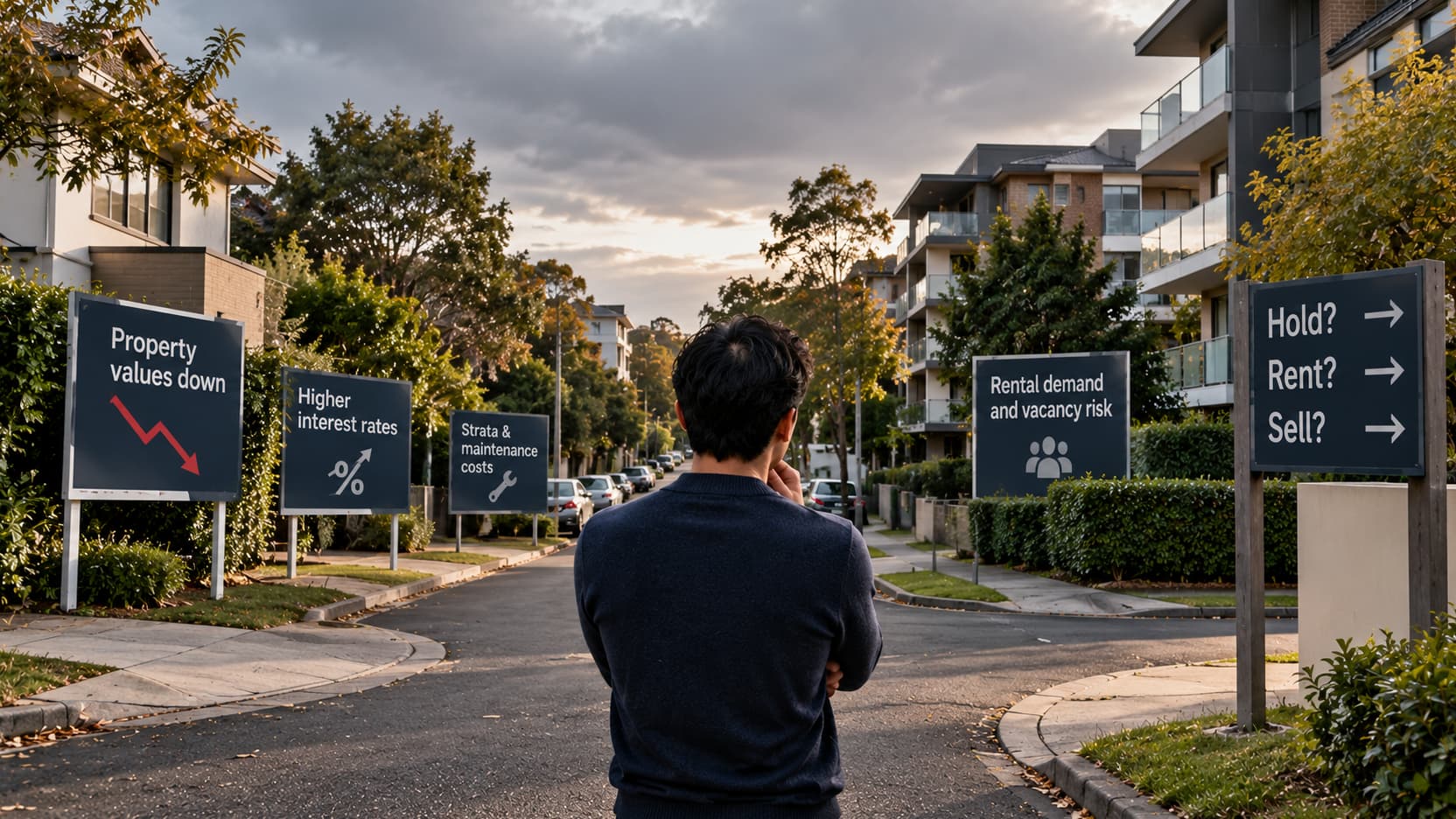
When property prices decline, homeowners and investors often face an uncomfortable question: should they hold on and wait for a recovery, or sell before their financial position deteriorates further?
The answer is rarely straightforward.
Recent reporting by the Australian Financial Review has highlighted the growing risk of negative equity among highly leveraged Australian homeowners, particularly first-home buyers who entered the market with smaller deposits.
But for Sydney property investors, negative equity is only part of the picture.
At YAY Real Estate, we believe the more important question is whether a property remains financially sustainable, commercially competitive and aligned with its owner's longer-term objectives.
A Falling Property Value Does Not Automatically Mean a Bad Investment
Property markets move in cycles. A decline in market value does not necessarily mean an investment has permanently failed.
An investor who purchased a property several years ago may still hold substantial equity despite a recent correction. Another investor who purchased near the market peak with a small deposit may face a very different financial position.
The distinction matters.
Negative equity occurs when the outstanding mortgage exceeds the property's current market value. While this creates financial risks, particularly when refinancing or selling, it does not automatically require the owner to dispose of the property.
For investors who can comfortably service their loans, maintaining ownership may remain a reasonable strategy.
However, the ability to hold a property should not be confused with whether holding it remains the best financial decision.
The Real Pressure Point Is Cash Flow
For investment property owners, falling prices are often less immediately damaging than sustained negative cash flow.
Mortgage repayments are only one component of ownership costs.
Council rates, strata levies, insurance, property management fees, maintenance, unexpected repairs and vacancy periods all influence the true cost of holding an investment.
Consider a hypothetical Sydney apartment generating $850 per week in rent.
That represents $44,200 in annual gross rental income before expenses.
If mortgage interest, strata contributions, council rates, insurance, maintenance and other costs exceed that income, the owner must fund the shortfall from other resources.
This may be manageable for some investors. For others, particularly those facing higher borrowing costs or significant special levies, it can place considerable pressure on household finances.
A property can remain a sound long-term investment while still creating serious short-term financial stress.
The key is understanding how much that stress costs and how long it can realistically be sustained.
Not All Sydney Properties Will Recover at the Same Pace
One assumption worth challenging is that every property will recover simply because the broader Sydney market eventually improves.
Property performance varies significantly by location, building quality, supply, buyer demand and ongoing ownership costs.
A well-maintained family home in an established neighbourhood may behave differently from an apartment in a development with substantial competing supply.
Similarly, two apartments within the same suburb may have very different investment prospects if one building faces major defects, expensive remedial works or escalating strata contributions.
Investors should therefore assess their individual property rather than rely solely on Sydney-wide price movements.
The relevant questions include:
Is the property attracting consistent rental demand?
Is its rent competitive with comparable properties?
Are ownership and maintenance costs sustainable?
Does the building face significant future capital expenditure?
Would the capital tied up in this property be better deployed elsewhere?
These considerations may matter more than short-term movements in a city-wide property price index.
Before Selling, Examine the Rental Strategy
For some investors, improving rental performance may provide breathing room during a market downturn.
That does not necessarily mean increasing the rent aggressively.
An appropriate rental review should consider current comparable leases, tenant retention, property condition and prevailing market demand.
An unrealistic asking rent can create extended vacancy, potentially outweighing the benefit of a higher weekly figure.
For example, an additional $20 per week produces $1,040 in annual gross rent if the property remains occupied throughout the year.
By comparison, two weeks of vacancy at $850 per week represents $1,700 in lost rent.
A disciplined leasing strategy should therefore focus on sustainable rental income, not simply achieving the highest advertised price.
For existing tenancies, any proposed rent increase must also comply with applicable NSW tenancy legislation and notice requirements.
Good property management cannot eliminate market risk, but it can help owners control avoidable losses.
When Selling May Be the Better Decision
Holding a property is not always the right answer.
There are circumstances where selling, even during a weaker market, may protect an investor's longer-term financial position.
These include prolonged cash-flow pressure, substantial upcoming capital expenditure, changing personal circumstances or an investment that no longer meets its owner's objectives.
A property requiring repeated financial contributions may eventually become more costly to retain than to sell.
However, selling also involves expenses, including agent fees, marketing costs, potential loan discharge costs and possible tax consequences.
If the property is in negative equity, the owner may also need additional funds to discharge the mortgage at settlement.
The decision should therefore compare the realistic net proceeds from selling today with the projected costs, risks and potential benefits of continued ownership.
Neither holding nor selling should be treated as the automatic answer.
Our Perspective: Make the Decision Based on the Property, Not the Headlines
At YAY Real Estate, our view is that a property downturn calls for greater financial discipline rather than emotional decision-making.
For some Sydney investors, the appropriate strategy will be to retain their property, optimise rental performance and allow time for market conditions to improve.
For others, a carefully planned sale may provide greater financial flexibility and reduce exposure to ongoing costs.
The important point is that every investment property has its own financial circumstances.
The question is not simply whether Sydney property prices will recover. It is whether owning this particular property remains the right decision for you while waiting for that recovery.
Before making a decision, investors should understand their property's current market value, realistic rental potential, ongoing holding costs and likely selling outcome.
A clear assessment of these factors is far more useful than attempting to predict the exact bottom of the property market.
Considering whether to hold, lease or sell your Sydney investment property?
YAY Real Estate can assist with rental market assessments, property management advice and sales appraisals to help you evaluate your options.
Source and further reading: Australian Financial Review, Jessica Penny, Why selling isn’t your only option when property values drop, 26 October 2026.
Disclaimer: This article provides general property market commentary only and does not constitute personal financial, taxation or legal advice. Property owners should seek appropriate independent professional advice before making investment decisions.