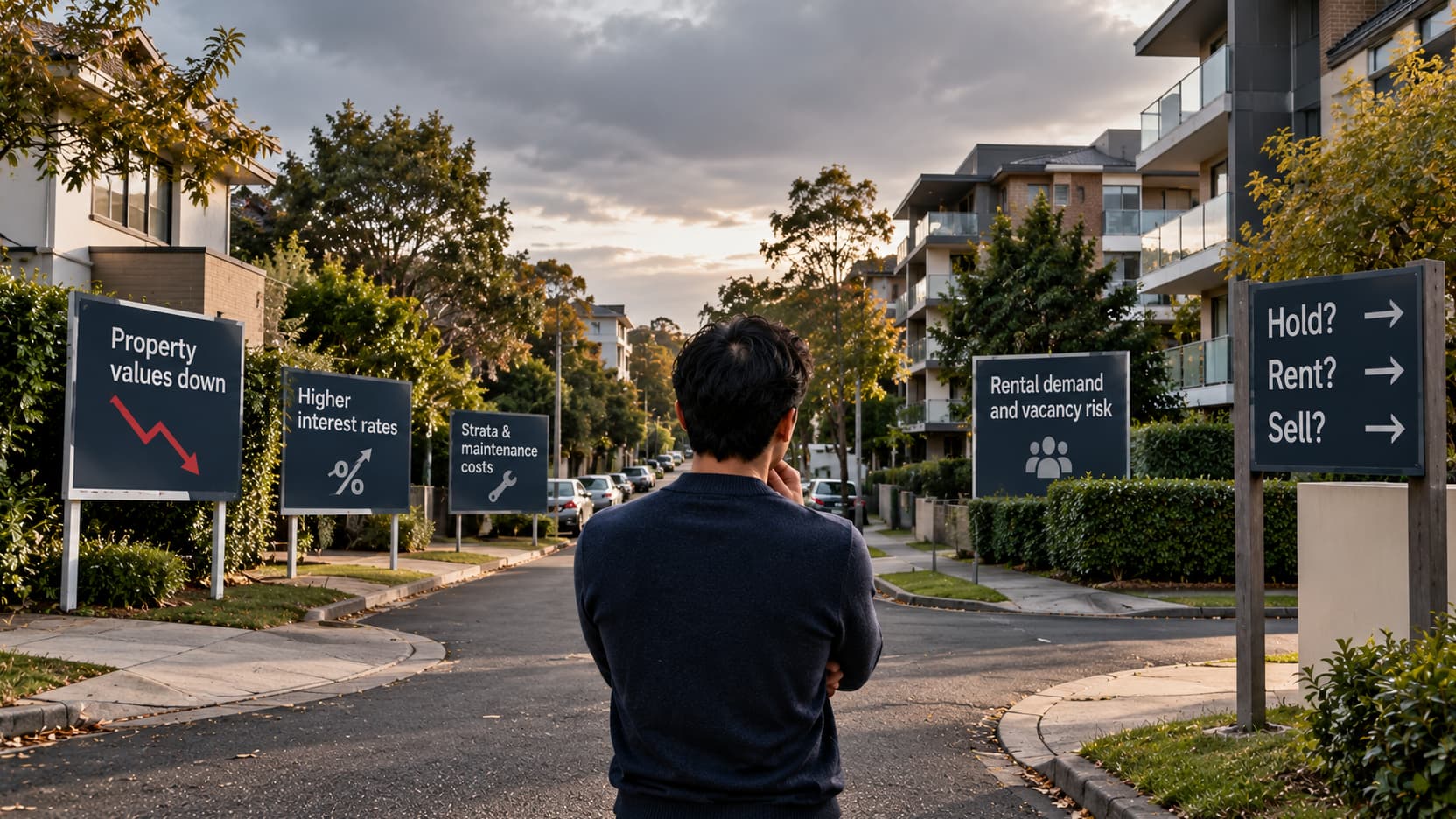

Australia's property market is entering a period that could challenge one of its longest-standing assumptions: that every significant downturn will eventually be followed by a relatively swift recovery.
The immediate focus is understandably on falling prices, higher borrowing costs and weakening buyer confidence. But the more important question may be what happens after prices stabilise.
What if the next recovery is slower, more selective and less dependent on property investors than previous cycles?
For Sydney buyers, landlords and property owners, that possibility deserves serious consideration.
Lending data is sending a warning
Commonwealth Bank's September-quarter 2026 trading update offers an important indication of changing conditions.
Home loan application volumes were 16% lower than a year earlier. The bank reported approximately $2.8 billion in quarterly cash profit, but mortgage arrears of 90 days or more increased to 0.80%.
Loan impairment expenses reached $300 million, equivalent to 11 basis points of average gross loans and acceptances.
These figures do not suggest that Australia's banking system is facing an immediate crisis. However, they demonstrate a growing divergence between the financial strength of major lenders and the pressures experienced by individual borrowers.
Higher interest rates are reducing borrowing capacity, while inflation continues to constrain household budgets.
Even financially secure buyers may be choosing to delay major purchasing decisions.
Importantly, weaker mortgage applications are not the same as falling property prices. They are an early indication of reduced demand, which must be assessed alongside completed sales, housing supply and local market conditions.
References: Commonwealth Bank · Reuters
Why this downturn may be different
Historically, Australia's housing market has benefited from several powerful recovery mechanisms: lower interest rates, population growth, limited housing supply and renewed investor demand.
Those forces have not disappeared. However, their relative influence may be changing.
Borrowing costs remain elevated, and changes to property-related tax settings may alter investment returns and purchasing incentives.
Investors who previously relied heavily on capital growth may become more selective, placing greater emphasis on rental income, financing costs and long-term holding expenses.
At the same time, affordability remains a significant obstacle for owner-occupiers.
Lower purchase prices do not automatically translate into cheaper home ownership when mortgage repayments remain high.
This creates the possibility of a market where prices stabilise without immediately returning to strong growth.
That is a scenario worth preparing for, rather than a prediction that every property market will experience a prolonged downturn.
References: Australian Financial Review
Sydney is not one property market
National housing statistics are useful, but they can conceal substantial differences between local markets.
Sydney's established family homes, high-density apartments, new developments and investor-oriented properties do not respond identically to changing economic conditions.
A well-maintained family home in a tightly held suburb may face very different competition from an apartment in an area with substantial new supply.
Strata levies, building quality, transport connections, school catchments and local employment access can all influence buyer demand.
Even neighbouring suburbs may experience different sales conditions.
For this reason, applying a single percentage decline to every Sydney property is neither accurate nor particularly useful.
The most important market evidence is often found at suburb, property-type and individual-property level.
What buyers should do
A softer market can create opportunities, but buyers should avoid confusing a lower asking price with good value.
Start with borrowing capacity and repayment affordability.
Consider whether the purchase remains manageable if interest rates stay elevated or household circumstances change.
Compare recent settled sales rather than relying solely on advertised prices.
Assess property condition, ongoing expenses and long-term suitability.
Trying to identify the exact bottom of the market is rarely a reliable strategy. Buying a suitable property at a sustainable price is generally more important.
What investors and landlords should do
For property investors, this environment places greater importance on cash flow and asset quality.
Rental income should be assessed against realistic expenses, including mortgage interest, insurance, council rates, strata levies, maintenance and potential vacancy.
Landlords should also consider the value of retaining reliable tenants.
An aggressive rental increase that results in an extended vacancy may produce a worse financial outcome than a carefully assessed adjustment supported by comparable leasing evidence.
Professional property management can help owners understand local rental demand, minimise avoidable vacancy and maintain the long-term condition of their assets.
Investment decisions should not depend on the assumption that capital growth will always compensate for weak rental returns.
What sellers should do
For owners considering selling, realistic pricing is increasingly important.
Recent comparable sales, competing listings, buyer enquiry and days on market provide a stronger foundation than historical peak prices.
Presentation, marketing and the timing of a campaign also matter.
A property that is positioned correctly may still attract serious buyers, even when broader market sentiment is cautious.
Conversely, an unrealistic asking price can extend the selling period and weaken negotiating leverage.
The appropriate decision to sell or hold depends on individual financial circumstances, property performance and future plans.
YAY Perspective: resilience matters more than timing the bottom
Our view is that the next phase of Australia's housing market will reward careful property selection and financial resilience more than speculative market timing.
Sydney will continue to have areas supported by established infrastructure, employment access and genuine housing demand.
However, not every suburb, building or investment strategy will perform equally.
Rather than assuming that the next recovery will resemble previous cycles, buyers and property owners should focus on decisions that remain sustainable under a range of market conditions.
For buyers, that means purchasing within realistic financial limits. For landlords, it means protecting rental performance and tenant retention. For sellers, it means understanding today's market rather than relying on yesterday's prices.
A changing market does not eliminate opportunities. It makes accurate local knowledge and disciplined decision-making more valuable.
This article provides general market commentary and does not constitute personal financial advice.