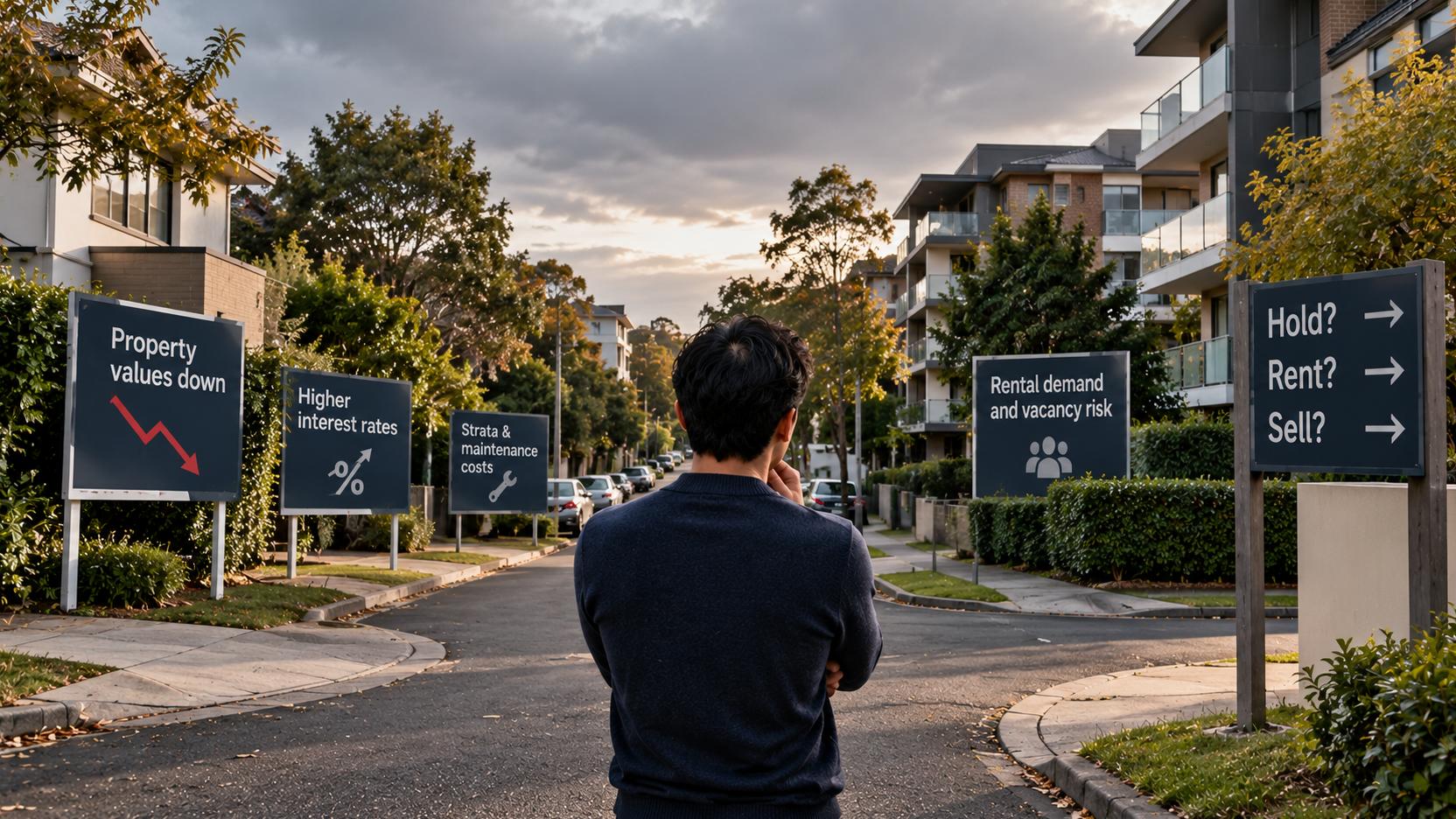
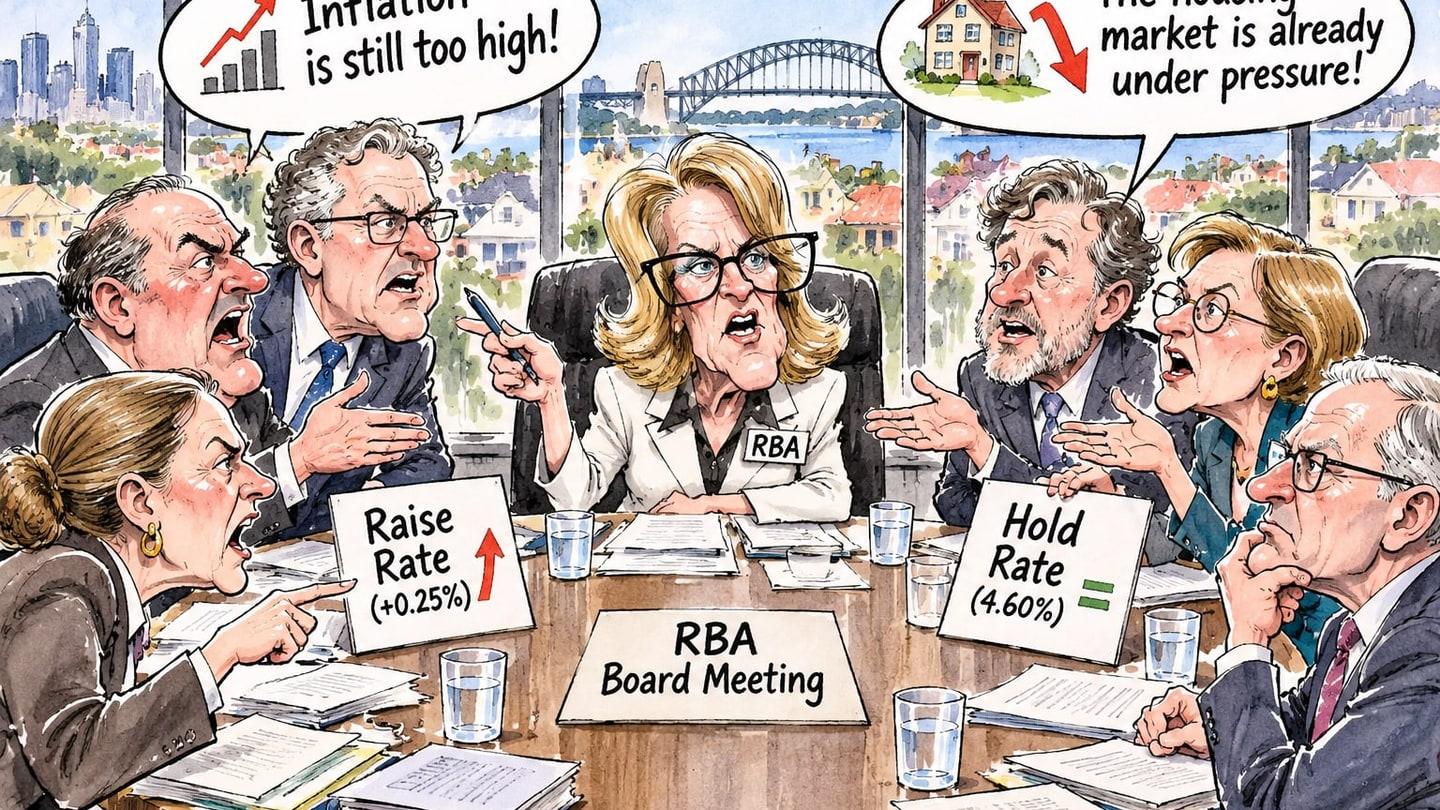
The Reserve Bank of Australia's November decision was significant not simply because interest rates increased again, but because the Monetary Policy Board was divided over the economic consequences.
A divided central bank, a more uncertain economy
At its 3 November meeting, six members voted to increase the cash rate target by 25 basis points to 4.85%, while three preferred to hold at 4.60%.
The majority remained concerned that inflation was proving more persistent than anticipated. The minority placed greater weight on the risk that previous interest rate increases were already slowing the economy, with potentially more severe consequences still to emerge.
Both groups were examining broadly the same economic evidence. Their disagreement concerned how to balance the risks of persistent inflation against the possibility of excessive monetary tightening.
References: Reserve Bank of Australia
Why this matters for property
For Australia's property market, that distinction matters.
Housing is not merely an asset class affected by interest rates. It is connected to household spending, employment, credit availability, construction activity and consumer confidence.
A prolonged housing downturn could therefore have consequences extending well beyond property values.
The hidden economic cost of fewer property transactions
Property prices attract most of the headlines, but transaction volumes can provide an equally important indication of market conditions.
The RBA's November minutes acknowledged that housing turnover had weakened significantly.
When fewer properties change hands, the consequences extend through a broad network of businesses.
Real estate agencies and conveyancers experience fewer transactions. Mortgage brokers and lenders see reduced demand for new loans. Removalists, furniture retailers, tradespeople and renovation businesses may also experience weaker activity.
The impact can accumulate even when headline property prices are declining relatively gradually.
This is particularly relevant in Sydney, where high property values mean that changes in borrowing capacity and buyer confidence can materially affect transaction decisions.
A prospective buyer might still have sufficient income to purchase a home but delay the decision because of uncertainty about employment, borrowing costs or future prices.
A seller may similarly withdraw from the market rather than accept an offer below expectations.
The result can be a prolonged period of weak turnover, with fewer transactions taking place despite continuing underlying demand for housing.
YAY Perspective: A decline in property turnover should not automatically be interpreted as a collapse in housing demand. It can also reflect a widening gap between buyers' borrowing capacity and sellers' price expectations.
However, sustained weakness in turnover can become an economic problem in its own right.
References: Reserve Bank of Australia
Why the RBA's minority is concerned
The three board members who preferred to leave rates unchanged were not necessarily arguing that inflation had been defeated.
Their concern was that the full effect of previous tightening had yet to appear in economic data.
The RBA had already delivered 100 basis points of tightening during 2026 before the November decision. Monetary policy typically affects households and businesses with a delay.
Higher mortgage repayments reduce disposable income, but the adjustment does not occur uniformly. Some households initially rely on savings or offset balances. Others reduce discretionary spending or postpone major purchases.
The RBA noted that household mortgage arrears remained low and that many borrowers retained substantial financial buffers.
These are important signs of resilience.
Nevertheless, financial resilience does not eliminate the possibility of weaker future spending. A household can remain current on its mortgage while significantly reducing expenditure elsewhere.
The Board discussed the risk that falling housing turnover could weaken economic activity by more than historical relationships incorporated into the RBA's central forecasts.
If that occurred, the consequences could extend into employment and household incomes.
The RBA's forecasts already anticipate the unemployment rate reaching approximately 5.1% by the end of 2028.
That is a forecast, not a prediction of an inevitable recession. But it illustrates why the timing and cumulative effects of monetary tightening matter.
References: Reserve Bank of Australia
The housing supply paradox
One of the more important issues raised in the November minutes concerns financing for residential development.
The RBA observed that funding conditions had tightened for private credit lenders, potentially reducing the availability of finance for property developers.
At the same time, lending for new housing had fallen sharply, particularly among investors.
These developments create a potential policy dilemma.
Higher interest rates may be necessary to control inflation, but they also increase financing costs and can make new housing projects less commercially viable.
Developers assess projects against expected selling prices, construction costs, financing expenses and the time required to complete and sell dwellings.
If borrowing becomes more expensive while buyer demand weakens, marginal projects may be postponed or abandoned.
The immediate effect is weaker construction activity.
The longer-term consequence could be fewer completed homes entering the market.
That distinction is important because Australia's housing affordability challenges cannot be resolved solely through weaker demand.
Additional housing supply remains necessary to accommodate population growth and changing household requirements.
YAY Perspective: A downturn that reduces new housing investment may temporarily ease price pressures while worsening the supply constraints that contribute to affordability problems over the longer term.
This outcome is not inevitable. Construction costs, planning approvals, population trends and government housing policies will also influence future supply.
Nevertheless, the relationship between monetary tightening and development feasibility deserves closer attention.
References: Reserve Bank of Australia
Sydney's sales and rental markets may move differently
For Sydney property owners and investors, the implications are not straightforward.
A weakening sales market does not automatically produce a corresponding decline in rental prices.
Sales prices are particularly sensitive to borrowing capacity, mortgage rates and expectations about future capital growth.
Rental prices are influenced by a different combination of factors, including household formation, tenant demand, available rental stock, incomes and the affordability of alternative accommodation.
Higher interest rates can place pressure on landlords with mortgages. However, those higher financing costs do not automatically translate into higher achievable rents.
Rents remain constrained by what tenants can afford and by competition from comparable properties.
Likewise, weaker investor purchasing activity does not immediately establish that rental supply will fall. The outcome depends on who buys or sells properties, whether dwellings remain available for rent, and how many new homes are completed.
The interaction between these factors may produce different outcomes across Sydney's suburbs and property types.
A well-located apartment with strong tenant demand could perform differently from a large detached home with substantial holding costs.
For landlords, the practical priority is therefore not simply predicting the next interest rate decision.
It is understanding the property's rental competitiveness, vacancy risk, maintenance requirements and net holding costs.
What buyers and investors should watch
The November vote does not establish that interest rates have peaked.
The majority of RBA board members remained concerned that monetary conditions might not be restrictive enough to return inflation sustainably to target.
Future decisions will depend on incoming economic evidence.
For property market participants, several indicators deserve particular attention.
Housing turnover: Continued declines could indicate that financing constraints and confidence are suppressing transactions more severely than expected.
Employment conditions: Rising unemployment would increase pressure on household budgets and could weaken both purchasing demand and rental affordability.
Investor lending: Changes in investor borrowing can provide information about confidence, financing conditions and potential future rental investment.
Development activity: Project commencements, approvals and financing conditions will help indicate whether the present downturn is affecting future housing supply.
Rental market conditions: Vacancy rates, leasing periods and achievable rents will remain more useful for individual investment decisions than broad national housing forecasts.
None of these indicators should be considered in isolation.
A market can experience falling prices while rental conditions remain relatively tight. Equally, stable prices can conceal deteriorating transaction volumes or weakening buyer demand.
References: Reserve Bank of Australia
The risk of getting the balance wrong
The RBA faces a difficult trade-off.
If monetary policy is eased prematurely, persistent inflation could undermine household purchasing power and require further intervention later.
If policy remains restrictive for too long, the cumulative impact on households, businesses and housing activity could become more damaging than anticipated.
The November minutes reveal a board divided over which risk currently deserves greater weight.
For Australia's property market, the central question is no longer simply whether interest rates will rise again.
It is whether housing weakness remains a manageable part of the inflation adjustment or develops into a broader constraint on economic activity.
That distinction will help shape the outlook for buyers, sellers, investors and developers over the coming year.
References: Reserve Bank of Australia
YAY Perspective: Our conclusion
Australia's housing downturn should not be assessed through property prices alone.
Transaction volumes, financing conditions, employment trends and new housing supply may ultimately provide a more complete picture of its economic consequences.
The RBA's November division is a reminder that monetary policy operates with uncertainty and delay.
For Sydney property owners, this argues for measured decisions rather than attempting to time the market around individual interest rate announcements.
Buyers should assess affordability under realistic financing assumptions. Sellers should remain responsive to comparable transactions and genuine buyer demand. Investors should focus on sustainable cash flow and property-specific fundamentals.
A weaker housing market does not necessarily mean a weaker long-term investment opportunity. But it does make disciplined pricing, financing and asset management more important.
This article contains independent market commentary by YAY Real Estate. Forward-looking assessments are interpretations of available information, not RBA forecasts or personal financial advice.